Production systems. Built to run after launch.
Cloud infrastructure, database architecture, API design, and custom software — built for businesses that have outgrown their current setup. If your operation still runs on spreadsheets, disconnected tools, or software that no longer fits, we replace it with something that does.
Websites and dashboards are part of the practice — not the whole of it. Every engagement runs on a monthly sprint with plain-English reporting. You always know what was built, what comes next, and what it cost.
Production systems. Click any link right now.
No case studies behind NDAs. No mockups of work we can't show you. Every system below is deployed, accessible, and interactive — built by this practice and running today.
HRH Operations Dashboard
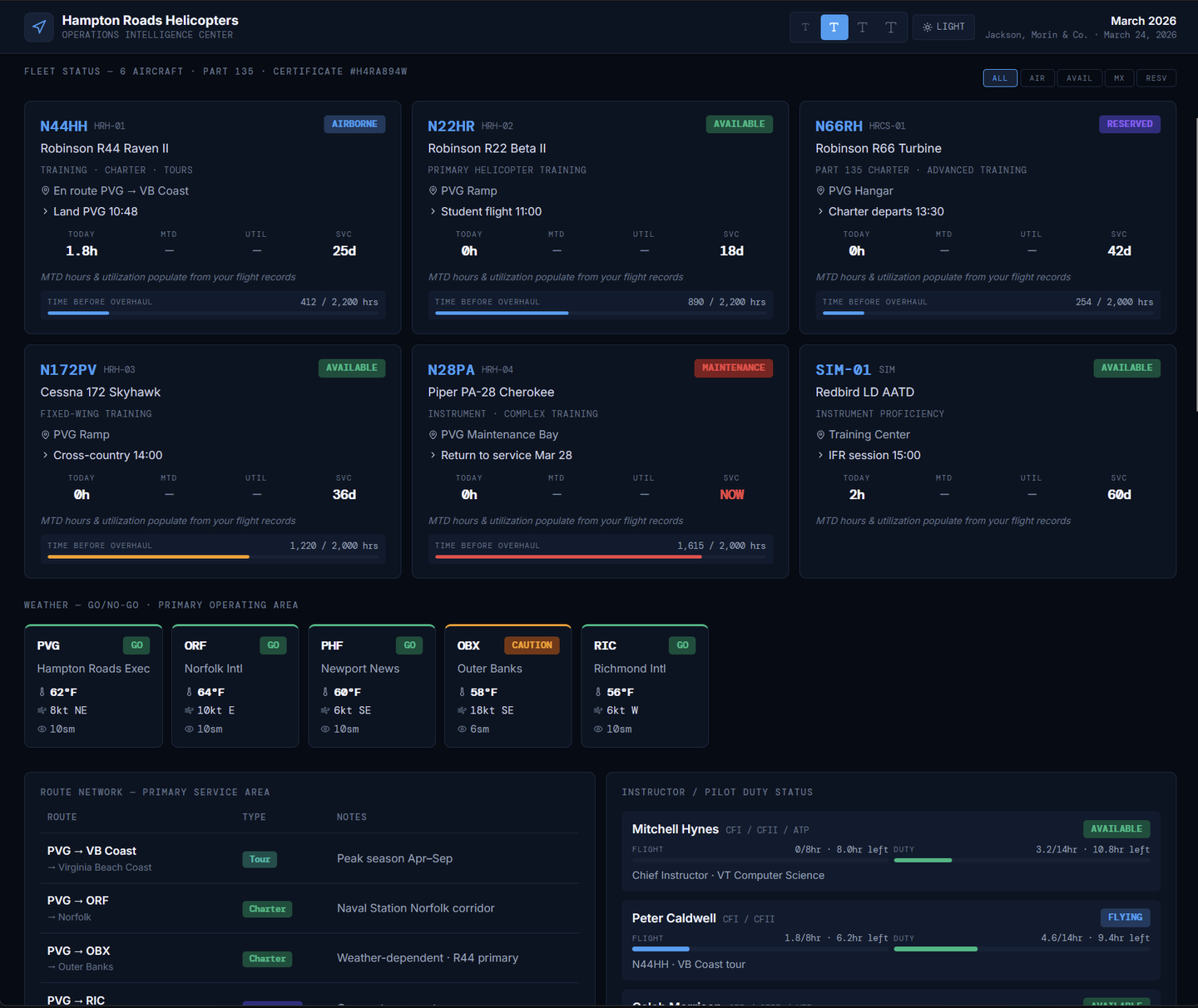
Operations intelligence center built specifically for Hampton Roads Helicopters — a real aviation company in Chesapeake, VA. Their actual fleet (R44, R22, R66, C172, PA-28, Redbird sim), their instructors by name, their routes, their maintenance schedule. Fleet status with TBO tracking, weather go/no-go, instructor duty hours, revenue by service line. Built before the first conversation as a demonstration of the spec-build model.
Archive Platform
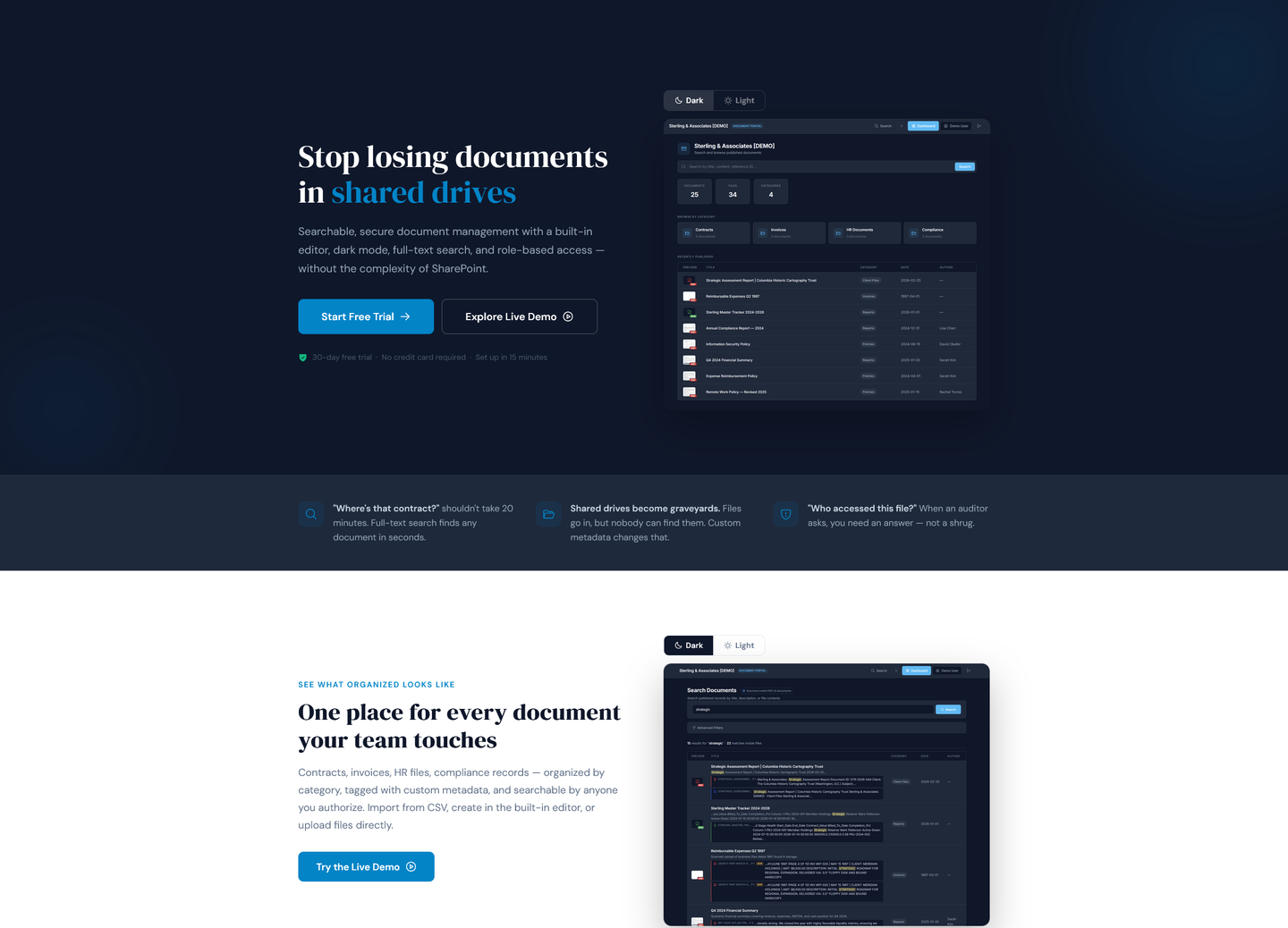
Multi-tenant document management SaaS serving archival institutions and business operators. Full-text OCR search across PDF, DOCX, and image content. Dynamic field builder, public portals, per-user dark mode, version history, retention compliance. 393+ automated tests across records and accounts modules.
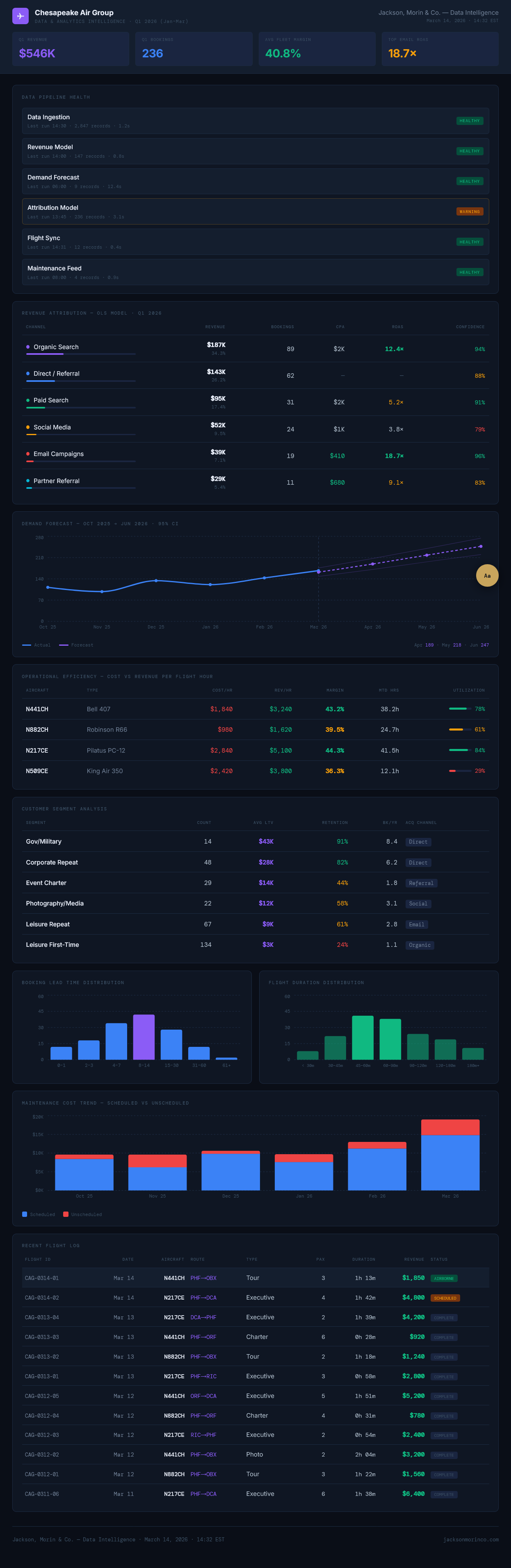
CAG Dashboard Suite
Three-layer analytics suite built for a charter aviation operator. Web analytics report (sessions, conversions, keyword rankings), live operations center (Leaflet map with flight paths, pilot duty-hour legality board, empty leg detection, weather radar), and deep analyst layer (OLS revenue attribution, demand forecasting with confidence intervals).
Harborview Marina
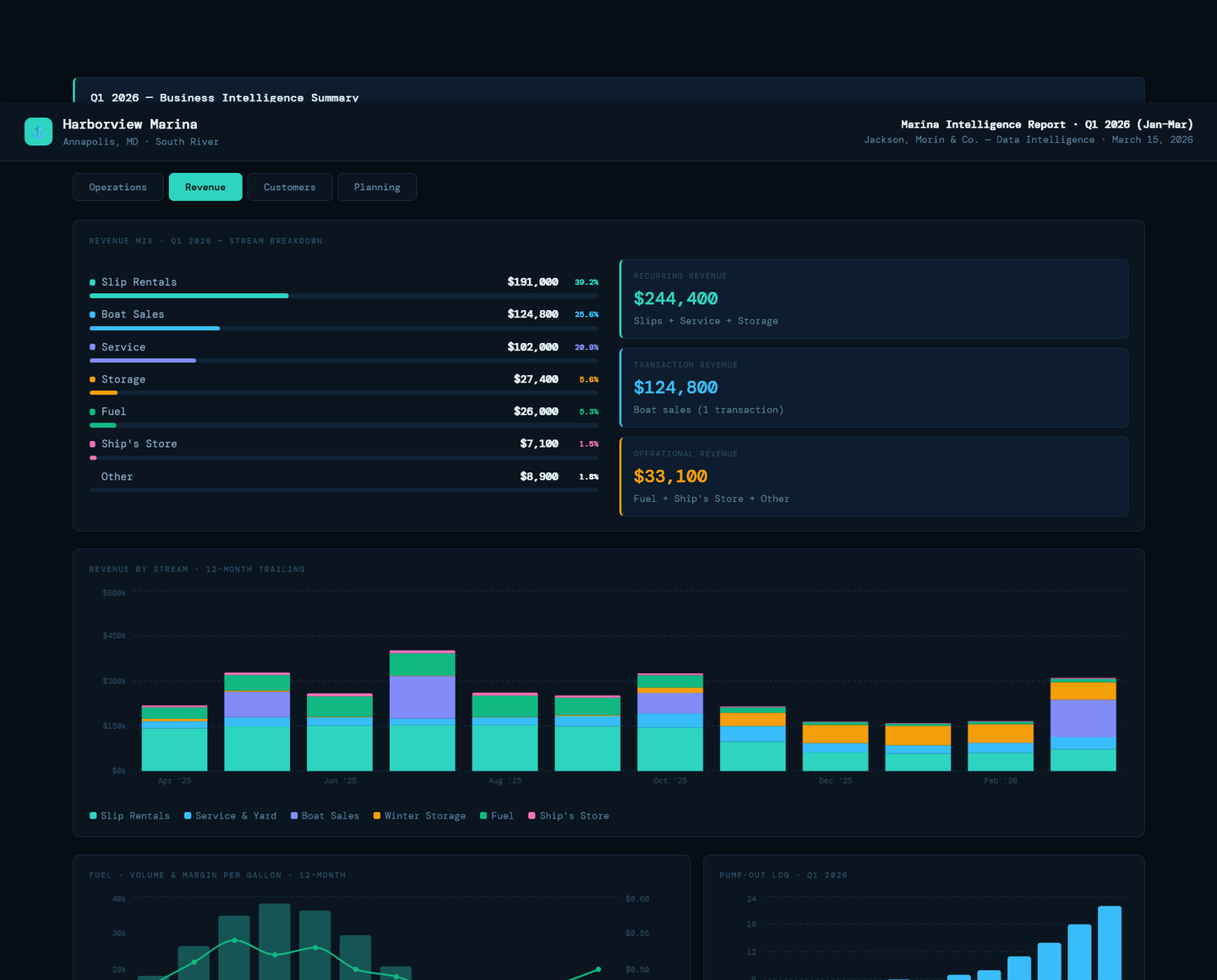
Four-tab marina intelligence platform. Slip occupancy with waitlist depth, dock utilization by section, 12-month revenue waterfall by stream, service yard ticket analysis, customer LTV cohort analysis with at-risk account flagging, and 18-month seasonal demand forecast. Built for Chesapeake Bay operators.
ESIP — Portfolio Dashboard
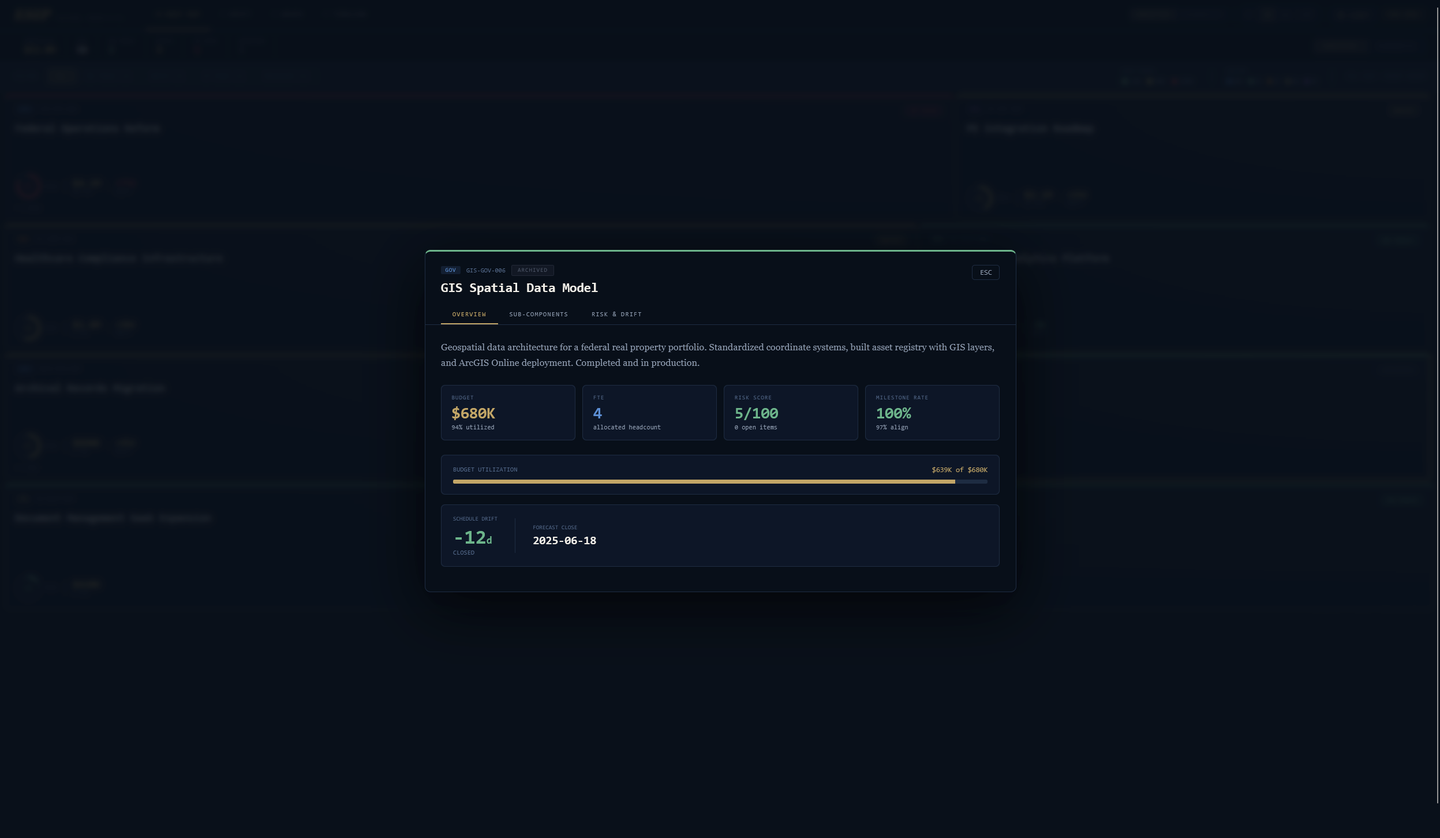
Internal executive dashboard for initiative and portfolio tracking. Strategic health heatmap with budget-weighted cells and risk-score borders, schedule drift analysis, dependency graph, and audit trail. Built as the portfolio anchor for the consulting practice — linked from the firm homepage.
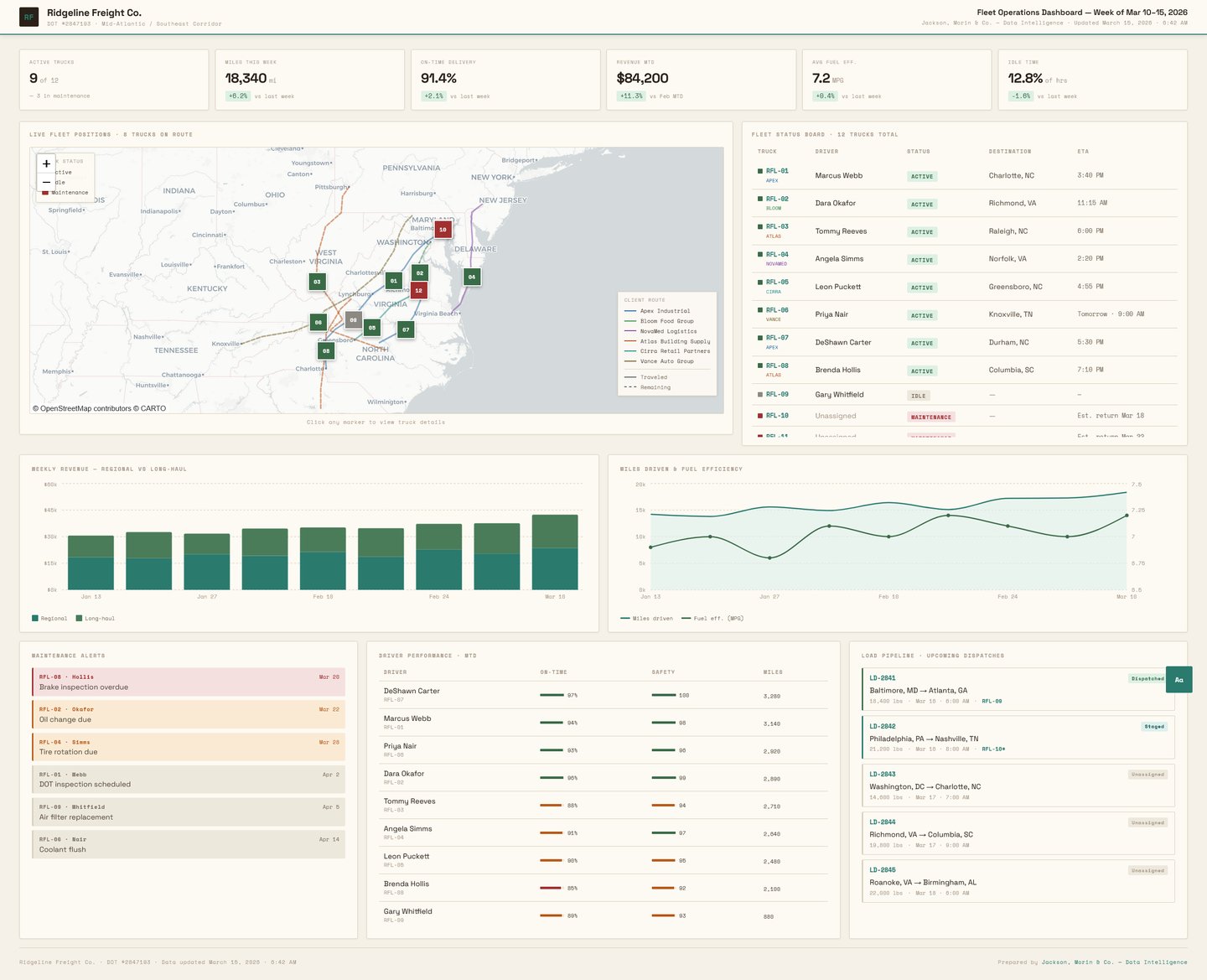
Ridgeline Fleet Operations
Real-time fleet management dashboard. Live truck positions on a Leaflet map, route tracking colored by client, fleet status board, weekly revenue breakdown, miles driven and fuel efficiency trends.
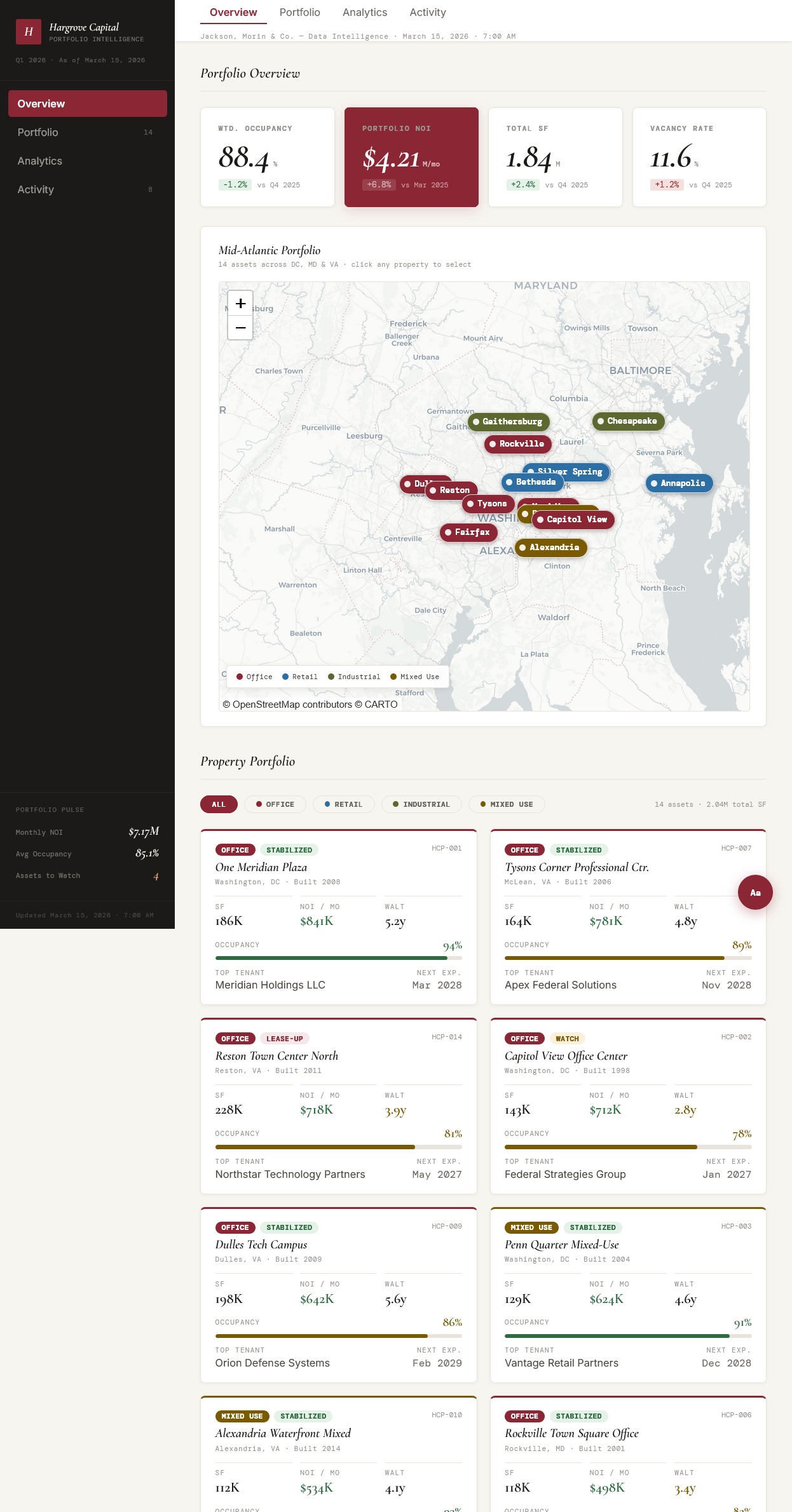
Hargrove Capital Partners
Commercial real estate portfolio dashboard. Sidebar navigation, KPI strip, Leaflet map with property pins, portfolio cards with occupancy bars, lease expiration timeline, NOI trends, and tenant concentration analysis across 14 assets in DC, MD, and VA.
TMG Analyst Intelligence
Deep analytics layer for Tidewater Marina Group. OLS revenue attribution by channel, seasonal demand forecasting with 95% confidence intervals, interactive rate scenario modeling, customer segment LTV by cohort, asset efficiency matrix, and live pipeline health monitoring.
Infrastructure. Software. Data. Websites. One standard.
Whether it's a $1,500 website prototype or a $25,000 SaaS platform, every project runs on the same sprint methodology, the same reporting cadence, and the same standard for what "done" means.
Cloud, database, and backend architecture
Cloud hosting (AWS, GCP, Fly.io, Vercel), database design and schema architecture, REST and GraphQL API development, DevOps and CI/CD pipelines. When your business has outgrown what it's running on, we build something better.
If your operation lives in spreadsheets, runs on software that no longer fits, or stores data in ways that make it hard to use — that's the work. We design and build the underlying infrastructure that makes everything else possible.
The software that does not exist off the shelf
Internal tools, client portals, SaaS platforms, and automated workflows built to your exact operational requirements. Generic software is built for the average business. Custom software is built for yours.
The Archive Platform is the in-house reference implementation — a multi-tenant document management SaaS running in production with 393+ automated tests, full-text OCR search, multi-tenancy, Stripe billing, and role-based access control.
Analytics layers and operational reporting
Dashboard architecture for business owners who need to see what is actually happening — not just summary numbers, but attribution models, demand forecasts, efficiency matrices, and decision-support tools built on your real data.
Built from first principles in your industry’s terminology. Not a BI tool configuration — a purpose-built reporting layer that connects directly to your operational systems and gives you answers in plain language.
Prototypes that sell themselves
We rebuild your website before the first conversation — using your real content, real photos, and real services. You see the finished product before you commit. Every site ships with GA4 analytics from day one.
When your business has grown past generic software: custom internal tools built for your exact workflows consistently outperform generic SaaS at a fraction of the long-term cost.
The monthly sprint cycle.
Every engagement runs on a four-week rhythm. You always know what is being built, what was shipped, and what is coming next.
Sprint kickoff and feature mapping
We open each sprint with a scoped feature map — what is being built, in what order, and against which epics. Scope is confirmed before a line of code is written. Surprises are a planning failure, not a development hazard.
Sprint plan deliveredIterative build with staged reviews
Active development with preview deployments throughout. Each feature deploys to a staging URL before entering the main branch. You can see and test work as it is built — not only at sprint close.
Preview deployments on requestProduction deployment and executive report
Sprint closes with a production deployment and a formal written report: what shipped, what was deferred and why, velocity, and proposed scope for the next cycle. A document your stakeholders can read in under five minutes.
Executive report deliveredFour operating commitments.
Monthly Sprints
Scoped, time-boxed, and documented. Every sprint begins with a plan and ends with a report. No open-ended billing.
Epic-Based Feature Mapping
Work organized into epics with features and acceptance criteria. You always know where a piece of work sits in the larger build.
Executive Reporting
Formal written report at sprint close. Velocity metrics, deployment notes, deferred items, next cycle recommendation.
Iterative Delivery
Staged deployments throughout the sprint. Work is reviewable before it ships to production. No big-bang launches.
A document your leadership can read in five minutes.
At the close of every sprint, you receive a formal executive report: what shipped, what was deferred, velocity against the plan, and a recommendation for the next cycle.
Designed for principals and stakeholders — not developers. Is the project on track? What completed? What changed and why?
- ✓Sprint velocity vs. planned scope
- ✓Features shipped with deploy notes
- ✓Deferred items with rationale
- ✓Epic progress across the engagement
- ✓Recommended scope for next sprint
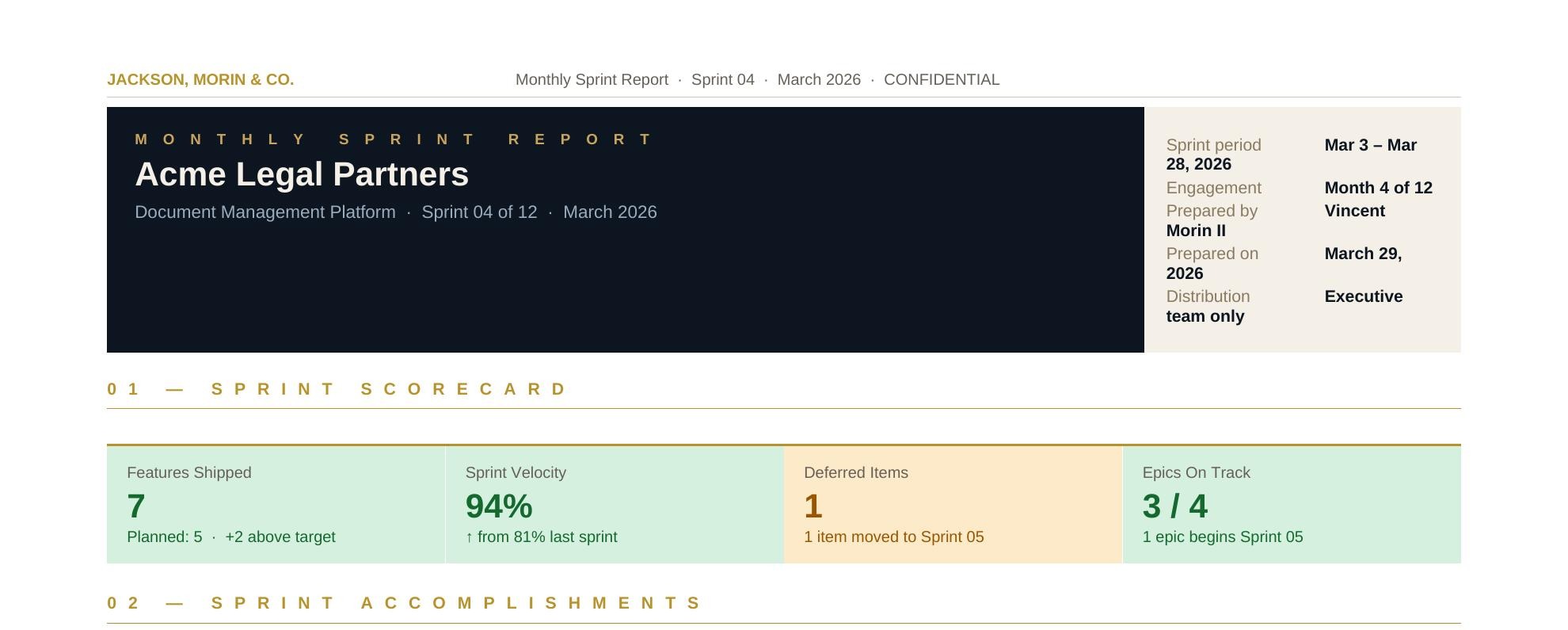
Every report opens with a sprint identity block and a four-tile scorecard — features shipped, velocity, deferred items, and epic health. Executives read this line in under ten seconds.
SAMPLE · MONTHLY SPRINT REPORT · SPRINT 04 OF 12 · ACME LEGAL PARTNERS · MARCH 2026
Epics before estimates.
Before we price a sprint, we map the work. Every engagement begins with a structured feature map organized into epics with constituent user stories and acceptance criteria.
An epic is a unit of meaningful capability — "Billing & Stripe Integration" is an epic. "Stripe checkout session with webhook handling" is a feature inside it. This keeps work traceable from business objective to deployed code.
Epics give you a language to manage the work without needing to be a developer. Reprioritize at the sprint boundary without disrupting active development.
The engagement structure.
We work on monthly retainer — not project bids. Retainer engagements produce better software because the relationship continues after launch. The software improves as your business evolves.
Foundation
Discovery, architecture, and the first working build. Establishes the technical foundation and delivery cadence.
- —Technical discovery and architecture document
- —Feature map with epics and priorities
- —First production deployment
- —Handoff documentation
Development Retainer
Monthly sprint retainer. Ongoing feature development against the agreed epic map, with formal reporting at each cycle close.
- —Monthly sprint plan and kickoff
- —Active development, 3-week build window
- —Staged preview deployments
- —Monthly executive report
- —Priority adjustments at sprint boundary
Hosting Retainer
Post-launch retainer. Uptime, platform maintenance, and a standing quarterly roadmap review.
- —Platform monitoring and uptime
- —Security and dependency updates
- —Minor copy and content changes
- —Quarterly check-in and roadmap review
Every engagement starts with a discovery conversation. We scope the feature map, agree on an initial sprint budget, and establish the reporting cadence before any work begins. The first conversation is always free.
Tell us what your business needs right now.
A website, a dashboard, a platform, or all three — tell us what you're working with and we'll build the prototype before the first call. No pitch deck. No discovery questionnaire. Just the work, delivered.